Why multiple angles matter
A photograph is a 2D projection. Depth has to be inferred from shading, limb overlap and known proportions, and a single view leaves too much ambiguous.
Side views carry disproportionate value because they reveal depth that front and back views cannot.
The practical set
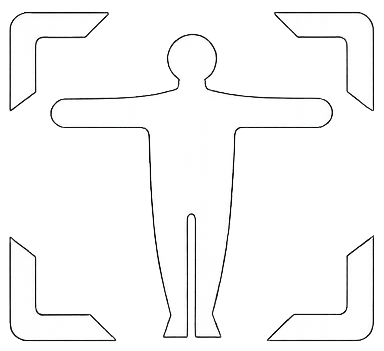
- Front — facing the camera, arms slightly away from the body.
- Left side — reveals waist depth and torso profile.
- Right side — confirms symmetry and depth from the other side.
- Back — essential for shoulder width and back length.
The side views are what make waist estimation work. Front and back alone often understate depth, and waist is already the measurement with the largest error.
Why waist is the limiting factor
Published smartphone validation reports errors of 6.1 cm at the waist, against 2.5 cm at the arm. Waist is a curve seen edge-on from any single angle.
Two side views give the system a depth profile, which is the single most valuable thing you can provide.
Consistency between shots
Your pose must be identical across all four. Weight even, arms in the same position, same distance from the camera. A slight change in stance between shots introduces error larger than the improvement from the extra view.
If the system allows a timed capture sequence, use it. It exists to enforce exactly this.
What degrades accuracy
- Loose or flowing clothing hiding the waist.
- Arms pressed against the torso, merging the silhouette.
- Hard directional light casting shadows.
- Cluttered backgrounds.
- Long hair covering the shoulders.
- A cropped frame cutting off feet or head.
How good is good enough
If you are choosing between sizes, roughly 6 cm of waist error is workable because most size steps are larger than that. If you are ordering made-to-measure, it is not.
For high-stakes purchases, verify the critical measurements manually.
Preparation details in what to wear and how to stand.